


The best-paying tech companies administer a system design round as part of their final-stage interview rounds. This interview, the successor to the classic whiteboarding exercise, challenges you to architect a complex system on iOS:
Show me how you’d architect an encrypted messaging app.
Demonstrate how you’d structure a news feed on a social app.
Design an SDK fit for a large analytics company.
There are virtually no resources online (aside from expensive coaching) that teach you to tackle these interviews for iOS roles.
Until now.
I went through an extremely intensive interview grind at the end of 2025, and faced down three system design challenges at three different companies. I’m coming to you today with personal, hard-won experience.
The real meat and potatoes here is a full worked example: a real system design interview, demonstrating what you can expect from a system design round today and how to tackle the problem. For dessert, I’ll highlight all the parts of prep work that were actually useful, so your own grind can be efficient and (mostly) painless.
A framework to structure every interview
A lot of interviewers these days will try to pretend that your interview is a casual chat. Don’t be fooled. Obviously, act natural, smile, but it will never hurt you to introduce some formality via a framework.
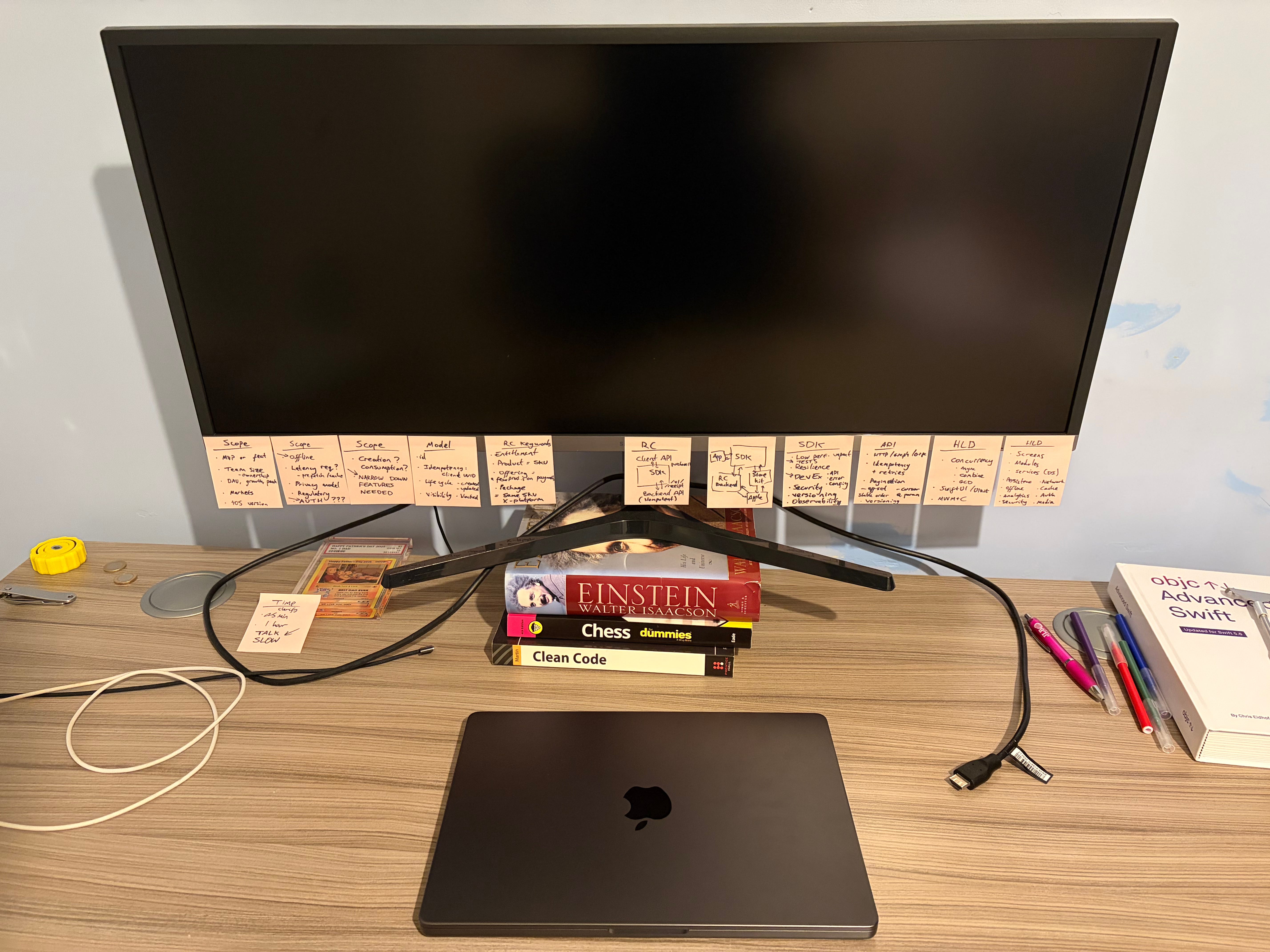
A framework is a simple structure you can follow to answer the problem. A reusable way of arranging your thoughts while you design the system. The framework goes like this:
Scoping
Functional requirements
Non-functional requirements
Data model
API design
High-level design
Drill-down questions
With system design, “measure twice, cut once”. You must understand the problem space and what needs to be designed before you draw anything.
As iOS developers, it’s tempting to dive straight into SwiftUI vs UIKit, MVVM vs MV vs VIPER, and your favourite concurrency toolkit. That’s a dangerous game: the system design interview is far more about data flow and structure than UI or frameworks.
Now let’s look at a full worked example of an interview, demonstrating how to tackle the interview systematically. This might be the best prep out there, because it’s based on three of the real final-stage panel interviews I did last month.
My worked example takes you through the most popular system design question out there today.
By the end, you’ll have the confidence to tackle your own iOS system design round.
Upgrade to unlock this article, plus much more:
🌟 Access Elite Hacks, my exclusive advanced content
🚀 Read my free articles a month before anyone else
🧵 Master concurrency with my full course and advanced training
